April 14, 2011

Get Bitten by the News Bug!

Get Bitten by the News Bug!

The Pew Research Center’s Project for Excellence in Journalism has recently released a survey which shows that the amount of people who get their news online has surpassed the number of people who get their information via newspapers. Forty-six per cent of Americans surveyed get their news online approximately three times throughout the week compared to forty per cent who get info through print media.
Getting news and information through televised broadcasts is still the leading platform, with fifty per cent of Americans getting their news from TV bulletins. What’s also incredibly interesting is that nearly half of Amercians surveyed – a fascinating forty-seven per cent – get their news from mobiles, especially when it relates to local matters.
News blogs can be a great source of traffic
Their report also shows that there is a steady decline when it comes to people getting their information through from traditional media. Every media sector apart from online is losing an audience in some shape or other, and we feel this data is imperative to showing people how important posting regular news items on a company blog or other actually is.
With more people searching online than ever before for products, news, opinion and more, having an up-to-date news blog on your site can help to attract organic traffic as well as keeping your core visitors coming back to your site for more.
But your news blogs should always be original, objective and say something to your readers that no other site does. Your news should be sourced by yourself in-house and be relevant to your industry when it comes to search engine optimisation. The better the quality of your news when content writing, the more relevant it is and if a lot of care’s been taken when writing it, you should win over a lot of fans and followers for years to come if you keep it up!

April 13, 2011

Snaptu it, Facebook…

Snaptu it, Facebook…

Facebook is, frankly, enormous. Not just in a social networking sense, but also in a brand sense. A commercial sense and recognition sense. Over 30 million people in the United Kingdom currently possess a Facebook account, with that number steadily growing as time goes on.
While quite a lot of people access Facebook via their smartphone, there is still a huge number of people who log on through conventional handsets. Though the smartphone trend is ploughing ahead, a whopping 80 per cent of the global phone market is still taken up by ‘non-smartphones’.
Facebook has recently bought Snaptu
In what many see as a clever move, Facebook has quickly moved to acquire London-based company Snaptu for a price estimated between $40-70 million. The American-Israeli technology firm’s expertise lie in making social networks and platforms accessible through ‘feature phones’. One of Facebook’s key goals for 2011 is to expand in the mobile market – the team at Snaptu seem happy with the acquisition, blogging: “We soon decided that working as part of the Facebook team offered the best opportunity to keep accelerating the pace of our product development.”
In the past, Facebook’s head of mobile business, Henri Moisinnac, has said: “We want to have every user in every market using Facebook– we’re investing in smartphones and at the same time as in mass market phones because we believe with great features and great integrations, every phone can become sociable.”
Mobile search is becoming incredibly important in the world of website optimization as companies look to harness searchers on the move. With 80 per cent of the global phone market being identified as ‘non-smartphone’, then Facebook are already laying down the foundations to try and corner as much of it as possible. Link building is very important when promoting your website, but keep in mind that a strong mobile presence will also be crucial in the coming years as the medium grows.


Facebook Getting Tough on Profiles

Facebook Getting Tough on Profiles

Facebook and other social media websites are a vital part to search engine optimisation campaigns all over the globe. Making proper use of Facebook and similar platforms is a great way to increase your brand’s exposure across the web in SEO – but sadly, like a lot of things, there are people who try to take advantage of social media for quick rankings and to gain an advantage over the competition as quickly as possible.
Facebook has recently clamped down on profiles were they believe the user is underage, and has claimed that they’re currently deleting approximately 20,000 underage users every single day. Users looking to join Facebook have to be 13 or older, but because of the popularity of the medium, obviously a lot of people under 13 are trying their luck and joining the largest social website of our time!
Facebook deletes up to 20,000 profiles every day
But there are other underlying issues here. If a 12-year-old can create a profile, then anyone can create a profile, whether the reasons are for good or bad. There’s a difference between a kid joining Facebook to share photos with their friends and a company creating a lot of fake profiles to post a lot of fake, positive comments on the wall of their company page.
“There are people who lie. There are people who are under 13 [accessing Facebook]. Facebook removes 20,000 people a day, people who are underage,” says Mozelle Thompson, chief privacy advisor at Facebook. comScore rates that number to be much higher in the US, where their research shows that a possible 3.6million underage people regularly access Facebook.
It’s great to see that Facebook has recognised there’s something of a ‘profile problem’, and that they’re working hard to fix it where they can. How can they solve the problem though in the long-term? Leave us your thoughts below!


Twitter – Keep it Private.

Twitter – Keep it Private 

We’re massive fans of social media, and recommend it highly for anybody who’s looking to incorporate an SEO campaign alongside their web presence. But for all the benefits the likes of Twitter and Facebook can bring to an organic SEO campaign, people still have a hard time remembering that it’s a very public platform. Just ask Calvin Harris and Katy Perry…
It’s worth remembering that no matter how bad things get, either in a personal or professional sense, it’d be a wise idea not to air your dirty laundry in public. What’s the point?
Perry and Harris have been generating headlines over the last day or so because the latter has pulled out of the former’s tour around the UK. Harris cited behind-the-scenes issues, but instead of things staying that way and both parties sorting things out amicably, a slanging match erupted between Harris and Perry on Twitter, with thousands watching.
Katy Perry and Calvin Harris have been arguing over Twitter
Of course, this is a very high-profile incident between two chart stars, but there’s lessons for everyone to learn here. Many people still, understandably, confuse Twitter as an innocent form of fun. Twitter though, is regarded as a valid form of publishing and can carry all the associated legal consequences – just ask ex-Liverpool FC footballer Ryan Babel who was hit with a hefty fine for his tweets in January.
The tweets between Harris and Perry focused a lot on what many assume were the terms of the deal between the two, with talk of ‘goalposts being moved’. Pretty dangerous when each tweet will be read by potentially millions of people.
Whatever the problems you encounter in your business, deal with it professionally. Twitter can very easily – as the example above shows – turn things into a public slanging match, adding fuel to the fire. Keep things in-house. You not only owe it to yourself, but to the poor souls who follow you and have to read your tweets!


Five things you must do when using social networking websites for SEO

Five things you must do when using social networking websites for SEO

It is impossible not to notice the increasing popularity of social networking websites such as Facebook and Twitter. Millions of internet users now use websites of this kind on a regular basis and it is not just those using them for personal and social reasons that are logging in. Online business owners are developing and updating profiles on social networking sites and for some, this is making a big difference to their search engine optimisation campaigns.
If used appropriately, a social networking website can help a business to gain exposure, build trust and respect for its brand and direct traffic to its web pages. These are impressive results and are why so many site owners are becoming interested in what social networking websites can do for them and how these results can be achieved.
If you want to use social networking websites successfully as part of your SEO campaign, there are five things you must do:
1. Be polite. You are representing your company when you interact with others within social networking environments and must remember this at all times. You must always be polite and respectful if you want to show others the professionalism of your business.
2. Provide relevant information. Whilst all the content you create does not have to be about your business, a lot of it should be. This is because this is what a lot of your followers will expect and will be one of the main reasons why they are following you.
3. Be fun. If you are going to keep the attention and interest of your audience, you not only have to provide useful information but you have to make things fun too. There are many ways this can be achieved such as by running competitions, having quizzes, giving free prizes away and other ideas such as this. You do not always have to be serious when using social networking sites for SEO.
4. Be ready to respond to others. When using social networking websites, it is not just about giving information to others but also about reading their responses, communicating with them and learning from the information they offer you. If another user makes a comment, try and respond. Always acknowledge those that show an interest in your profile and try to help bonds between you and them to develop.
5. Be sociable. If you are not ready to be sociable on behalf of your business then there is little point in using sites of this kind. You have to check on your social networking page often, add information, respond to others, comment on the profiles of others and really get involved in the social networking community any way you can. This is how you will gain the most exposure.
We at the-websol.blogspot.com are helping many of our clients to establish themselves within the social networking communities and are seeing impressive results. If you require some help with sites like this or with any other SEO techniques, we are here to offer our assistance.


AdWords Finally Gets Phone Support

AdWords Finally Gets Phone Support

It’s something that those who have been involved in search engine marketing have been crying out for for years! But the day has finally come – Google has announced that it now provides phone support for its AdWords program, meaning that people will hopefully be no longer stuck in the wilderness when they need questions answering about their PPC campaign.
It’s taken Google nearly ten years to implement this most basic of measures, but better late than never! We’re still waiting to test it ourselves to see how effective it is, but anything has to be an improvement on the methods used beforehand. Previously, getting an answer out of Google in regard to an account was a hugely drawn-out process. If the solution to your problem wasn’t on the official Google FAQ then email was pretty much your only saving grace, with responses and replies taking days at a time to resolve matters.
Google has added phone support for AdWords
Which is a shame because pay per click is an incredibly effective form of SEO, and Google’s main form of revenue. You’d think, in that sense, that they would do everything they could to make the service as accessible as possible. No use in complaining now though, a problems been identified and fixed, and we’re looking forward to seeing how easy accounts are now to manage in a practical sense.
As far as SEO services go, PPC is a great tactic to employ for quicker results and an overall long-term improvement in your ROI – as long as you have the budget, that is. PPC can be an expensive business, but a good campaign done the right way can get you fantastic results!

April 11, 2011

Google Has Stopped Street View Photography In Germany

Google Has Stopped Street View Photography In Germany

street-view-car-small
In most locations, Google sends its Street View cars out on a repeated basis “to make sure the information is accurate and kept up to date,” as the Street View website explains.
But that’s not happening in Germany.
Despite the recent German court ruling that declared photography from streets legal in Germany, Google has stopped Street View photography there and says it has “no plans to launch new imagery on Street View in Germany.” A Google spokesperson says the company’s priorities have changed:
Our business priority is to use our Google cars to collect data such as street names and road signs to improve our basic maps for our users in a similar way that other mapping companies do.
Google will continue to show its existing Street View photos for the 20 German cities that are online now, but there won’t be any updates to those photos. It’s unclear if this decision is final, or if the company might change its plans in the future.
Aside from the mention of new priorities, the company isn’t saying why it’s stopped Street View photography in Germany. It’s easy to assume that the service’s difficult birth has factored into the decision. German officials raised objections almost as soon as Google announced plans to launch Street View there. After lengthy negotiations, Google eventually agreed to let German residents opt-out of having their buildings appear online, and nearly 250,000 German households and businesses took Google up on that offer. I’m not a programmer, but I can’t help wonder if the presence of so many blurred buildings — and the potential challenge of updating Street View while maintaining their privacy — is a factor in Google’s decision.

Woman Follows Google Maps “Walking” Directions, Gets Hit, Sues

Woman Follows Google Maps “Walking” Directions, Gets Hit, Sues

Is Google responsible for giving out bad directions through its Google Maps service? We’re about to find out. After Googling walking directions for a trip in Park City, Utah, Lauren Rosenberg claims she was led onto a busy highway, where she was struck by a vehicle. She’s now suing Google for damages.
The case, Rosenberg v. Harwood, was filed in Utah, in the US District Court’s Central Division (Gary Price of ResourceShelf tipped us to it today). Harwood is Patrick Harwood, the person who actually hit Rosenberg, according to the suit. Both Harwood and Google are being sued in the same case, for damages “in excess of $100,000.”
Rosenberg used Google Maps on January 19, 2009, via her Blackberry, to get directions between 96 Daly Street, Park City, Utah and 1710 Prospector Avenue, Park City, Utah. Google provided these, telling her as part of the route to walk for about 1/2 mile along the calm-sounding “Deer Valley Drive.”
That’s an alternative name for that section of Utah State Route 224, a highway that lacks sidewalks, the case says. Rosenberg wasn’t warned about this, putting Google directly at fault in the accident, the case claims:
Defendant Google, through its “Google Maps” service provided Plaintiff Lauren Rosenberg with walking directions that led her out onto Deer valley Drive, a.k.a. State Route 224, a rural highway wit no sidewalks, and a roadway that exhibits motor vehicles traveling at high speeds, that is not reasonably safe for pedestrians. The Defendant Google expects uses of the walking map site to rely on the accuracy of the walking directions given….
As a direct and proximate cause of Defendant Google’s careless, reckless, and negligent providing of unsafe directions, Plaintiff Laren Rosenberg was led onto a dangerous highway, and was thereby stricken by a motor vehicle…
Here’s the route:
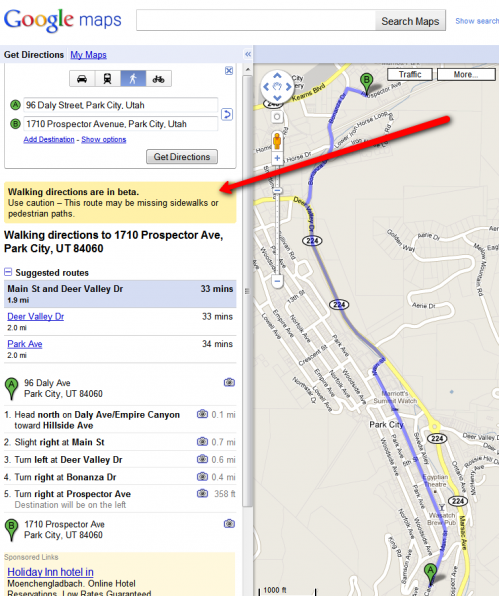
In the screenshot above, you can see that Google quite clearly warns:
Walking directions are in beta. Use caution – This route may be missing sidewalks or pedestrian paths.
That would seem to negate part of the suit’s claim — except that Rosenberg used a Blackberry. The Blackberry version of Google Maps might not have carried this warning. I don’t have a Blackberry so can’t see myself, but I’m checking on this. I know that on the iPhone version, there is no warning.
Certainly it seems embarrassing for Google to be routing people onto busy highways when they explicitly use the “walking” directions option. But then again, Google’s not alone. Bing does the same thing in its directions, which also contain a warning (at least in the web version):

Part of the issue seems to be that there’s no easy-to-find pedestrian path between these two points in Park City. Looking at the satellite view on Google Maps, there appears to be an alternative dirt path that runs roughly along the same direction. But I can’t tell if this was open to public use or not. Since it’s not along a major road, it’s something that Google Maps probably didn’t pick up.
Instead, Google’s making its best guess. That can be laughable to annoying, when it gets things wrong. Some examples:
  • Google used to advise swimming across the Atlantic Ocean to get from the US to Britain, as a joke
  • Google, before walking directions were added in July 2008, took a lot of ribbing for turning a 30 second walk in Sydney into an 18 minute car trip
  • When Google Maps rolled out its new bike directions feature in March, I found in my area, it made some wildly bad guesses
But are Google’s bad guesses also dangerous? I suspect a court is going to find that despite getting bad directions from Google (or a gas station attendant, a local person or any source), people are also expected to use common sense. So when you come to an intersection like this, as Rosenberg would have come to before crossing onto the highway:

You might be expected to consider for yourself whether it is safe to continue. Or when you’re walking down the road itself, and it looks like this:

It becomes self-evident there’s no sidewalk and probably not a good place for pedestrians to walk, regardless of whether you got a warning from Google or not.
Here’s to Google improving its directions and perhaps using more common sense of its own, understanding whether a street is a busy highway and maybe simply not offering routes when it doubt, rather than guessing.
And here’s also to common sense about anyone following any directions they’re given.

Reports: Google CEO Page Ties Bonuses To Social Success, Reorganizes Google Mgmt. Team

Reports: Google CEO Page Ties Bonuses To Social Success, Reorganizes Google Mgmt. Team


2011 bonuses for Google employees are reportedly being tied to how well the company fares in its efforts to integrate social elements across Google products. That’s according to two reports from Silicon Alley Insider — reports that say the news first spread in a company-wide memo last Friday from co-founder (and now new CEO) Larry Page.
There are also reports tonight that Page has promoted a half-dozen Google execs to new senior vice president roles; more on that below.
SAI has published a screenshot that it says is an internal Google FAQ describing a “2011 Multiplier” affecting employee bonuses. The screenshot says, in part:
For Googlers on the Company Plan, the multiplier has both an upside and a downside. It can range from 0.75 to 1.25 depending on how well we perform against our strategy to integrate relationships, sharing and identity across our products. If we’re successful, your bonus could be up to 25% bigger. If not, your bonus could be as much as 25% less than target. We all have a stake in the success of this effort and this multiplier is designed to reflect that.
(emphasis is mine)
Google’s missteps in the social space are well documented. Google Wave has already been shuttered, and Google Buzz has caused the company a number of headaches … not to mention lawsuits. Google bought services like Jaiku and Dodgeball, but later closed both.
Last September, Google began talking about a new plan: a social layer across its products. That plan has started to be realized in recent weeks with the expansion of social signals on search results’ pages, and last week’s launch of Google +1.
Page hints at the importance of Google Profiles when he refers to “identity” in the quote above. Most, if not all, of Google’s social efforts are dependent on getting searchers to create Google Profiles – and the company has been improving, promoting and emphasizing those for a few years now.
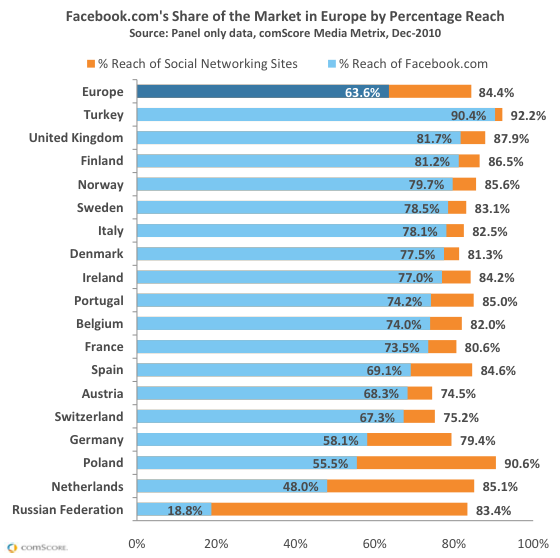
But for more and more Internet users, profiles belong to Facebook. Facebook gets about 25% of all US page views and was the most visited US web site in 2010. And it’s not just a US thing. Just look at comScore’s 2010 Europe Digital Year in Review, which reported that Europeans spend more time on Facebook than Google and showed Facebook’s dominant position among social networking sites in more than a dozen countries.
comscore-facebook-europe
So the big question might be this: Do users really want Google to be more social? Or has that ship already sailed? Google employees may get an answer in their Q4 bonus checks.
There’s more discussion of this on Techmeme.
Meanwhile, the LA Times is reporting that Page also completed a major overhaul of Google’s management structure today (Thursday). The Times reports the following promotions to new Senior VP status:
  • Andy Rubin to senior vice president of mobile
  • Vic Gundotra to senior vice president of social
  • Sundar Pichai to senior vice president of Chrome
  • Salar Kamangar to senior vice president of YouTube and video
  • Alan Eustace to senior vice president of search
  • Susan Wojcicki to senior vice president of ads

Gov’t To Okay Google-ITA Deal After Google Agrees To Burdensome Conditions


Gov’t To Okay Google-ITA Deal After Google Agrees To Burdensome Conditions

google-ita-featuredThe Justice Department (DOJ) has signed off on the Google acquisition of travel software company ITA, but says Google must meet certain conditions. The Justice Department said that as originally proposed the acquisition would have “substantially lessened competition among providers of comparative flight search websites in the United States.”
The DOJ is requiring Google to do a number of things if it wishes to proceed with the ITA acquisition:
Google will be required to continue to license ITA’s QPX software to airfare websites on commercially reasonable terms.  QPX conducts searches for air travel fares, schedules and availability.  Google will also be required to continue to fund research and development of that product at least at similar levels to what ITA has invested in recent years.  Google will also be required to further develop and offer ITA’s next generation InstaSearch product to travel websites, which will provide near instantaneous results to certain types of flexible airfare search queries.  InstaSearch is currently not commercially available, but is in development by ITA.
In other words, Google must effectively operate ITA as though the acquisition had not been made: continue software development and continue to license the platform to competitors. The proposed settlement also restricts how Google might use information it obtains from its operation of ITA:
To prevent abuse of commercially sensitive information, Google will be required to implement firewall restrictions within the company that prevent unauthorized use of competitively sensitive information and data gathered from ITA’s customers.  The proposed settlement delineates when and for what purpose that data may be used by Google.  Google is also prohibited from entering into agreements with airlines that would inappropriately restrict the airlines’ right to share seat and booking class information with Google’s competitors.
Beyond this, there will also be an enforcement mechanism to ensure that Google complies with the above and doesn’t do anything “unfair” with ITA:
The department said that Google will also be required to provide mandatory arbitration under certain circumstances and provide for a formal reporting mechanism for complainants if Google acts in an unfair manner.
It’s now Google’s move. The company could simply walk away from the acquisition or it could accept the DOJ’s settlement terms or fight the litigation.